


Technology changes the way people live and work every day. One of the biggest reasons for this change is machine learning. Today, businesses, hospitals, banks, schools, and online platforms use machine learning to improve their services. It helps computers learn from data instead of following only fixed instructions.
Many people use machine learning without realizing it. When Netflix suggests a movie, when Google shows search results, or when an online store recommends products, machine learning works behind the scenes. It studies patterns, learns from past data, and makes better predictions over time.
This guide explains everything about machine learning in simple language. You will learn how it works, why it matters, where companies use it, and what the future holds for this powerful technology.

What Is Machine Learning?
Understanding Machine Learning
Machine learning is a branch of artificial intelligence (AI). It allows computers to learn from data and improve their performance without being programmed for every task. Instead of following fixed rules, a machine learning model studies examples and finds patterns. It then uses those patterns to make predictions or decisions.
For example, an email service can learn which messages are spam. At first, it studies thousands of emails marked as spam or safe. Later, it uses that knowledge to identify new spam emails. The more data it receives, the smarter it becomes.
Today, machine learning helps businesses save time and improve accuracy. Companies analyze customer behavior, predict market trends, detect fraud, and automate many daily tasks. As more data becomes available, machine learning continues to improve its results and support better decisions.
Read for more info: https://technologycougar.com/data-privacy/
How Does Machine Learning Work?
The Machine Learning Process
Every machine learning system follows a series of steps. First, developers collect data from reliable sources. This data may include images, videos, numbers, customer records, or text documents.
Next, the data is cleaned. Incorrect or incomplete information is removed because poor-quality data leads to poor predictions. After cleaning, developers choose a suitable machine learning algorithm based on the problem they want to solve.
The model then trains using historical data. During training, it identifies relationships and patterns. Developers test the model with new data to measure its accuracy. If needed, they improve the model until it performs well.
Finally, the trained model moves into real-world use. It continues learning as new information becomes available. This continuous improvement makes machine learning valuable for businesses and organizations.
Types of Machine Learning
Supervised Learning
Supervised learning uses labeled data. Each training example already contains the correct answer. The model compares its predictions with the correct answers and improves over time.
Companies use supervised learning for spam detection, sales forecasting, medical diagnosis, and customer classification. Since the model learns from correct examples, it often provides highly accurate results.
Unsupervised Learning
Unsupervised learning works with data that has no labels. The model searches for hidden patterns without knowing the correct answers. It groups similar information together.
Businesses often use unsupervised learning for customer segmentation, recommendation systems, and market analysis. It helps organizations discover insights they may not notice manually.
Reinforcement Learning
Reinforcement learning allows computers to learn through rewards and penalties. The model performs actions and receives feedback. Positive outcomes receive rewards, while poor decisions receive penalties.
This method is popular in robotics, autonomous vehicles, gaming, and industrial automation. Over time, the system learns the best strategy to achieve its goal.
Benefits of Machine Learning
Why Businesses Use Machine Learning
The popularity of machine learning continues to grow because it provides many benefits. It improves productivity by automating repetitive tasks. Employees can focus on more valuable work while the system handles routine operations.
Another major benefit is accuracy. A well-trained machine learning model can analyze huge amounts of data faster than humans. It also reduces errors caused by manual work.
Businesses also use machine learning to improve customer experiences. Online stores recommend products based on browsing history. Streaming platforms suggest movies based on viewing habits. Banks detect unusual transactions before fraud occurs.
Healthcare organizations use machine learning to support disease detection. Manufacturers predict equipment failures before machines stop working. Farmers monitor crop health with smart technology. These examples show how machine learning improves many industries.
Applications of Machine Learning
Machine Learning in Healthcare
Healthcare organizations use machine learning to improve patient care. Hospitals analyze medical images, detect diseases early, and recommend treatments. Doctors also use machine learning to predict patient risks.
Wearable devices collect health information every day. Machine learning studies this data and alerts users when it detects unusual patterns. This helps people manage their health more effectively.
Machine Learning in Finance
Banks use machine learning to detect fraud, approve loans, and manage financial risks. The technology analyzes millions of transactions in real time. It quickly identifies suspicious activities that may indicate fraud.
Investment firms also use machine learning to study market trends. The technology helps analysts make informed investment decisions using historical and current data.
Machine Learning in Retail
Retail companies depend on machine learning to understand customer behavior. Online stores recommend products that customers are likely to purchase. Inventory systems predict future demand and reduce waste.
Businesses also use machine learning to personalize marketing campaigns. Customers receive advertisements based on their interests, improving sales and customer satisfaction.
Common Machine Learning Algorithms
Different machine learning algorithms solve different problems. Choosing the right algorithm depends on the type of data and the desired outcome.
| Algorithm | Main Purpose | Common Use Case |
| Linear Regression | Predict numerical values | Sales forecasting |
| Decision Tree | Classification and prediction | Customer analysis |
| Random Forest | Improve prediction accuracy | Fraud detection |
| Support Vector Machine | Data classification | Image recognition |
| K-Nearest Neighbors | Find similar data | Recommendation systems |
| Neural Networks | Learn complex patterns | Speech and image recognition |
| Naive Bayes | Probability-based classification | Spam filtering |
Challenges of Machine Learning
Data Quality and Availability
Although machine learning offers many benefits, it also faces several challenges. The biggest challenge is data quality. A machine learning model depends on accurate and complete data. If the data contains errors, duplicate records, or missing values, the model may produce incorrect results. This is why organizations spend a lot of time cleaning and preparing data before training a model.
Another challenge is data availability. Some industries do not have enough historical data to train reliable models. Small businesses may also struggle because they collect less information than large companies. Privacy laws can further limit access to valuable datasets.
Bias in data is another concern. If a dataset contains unfair or unbalanced information, the machine learning model may make biased decisions. Developers must regularly test and improve their models to ensure fairness and accuracy. High-quality data remains the foundation of every successful machine learning project.
Machine Learning Tools and Frameworks
Popular Platforms for Machine Learning
Many developers use modern tools to build and deploy machine learning models. These tools make the development process faster and more efficient. Some platforms are beginner-friendly, while others support advanced projects.
Python is the most popular programming language for machine learning because it offers many useful libraries. TensorFlow helps developers build deep learning models. PyTorch provides flexibility for research and advanced applications. Scikit-learn supports classification, regression, clustering, and data analysis. Keras simplifies neural network development and works well with TensorFlow.
Cloud platforms also play an important role. Google Cloud AI, Microsoft Azure Machine Learning, and Amazon SageMaker provide ready-made services for training and deploying models. These platforms reduce infrastructure costs and help businesses scale their machine learning solutions. As technology evolves, these tools continue to become faster, smarter, and easier to use.
Machine Learning vs Artificial Intelligence
Understanding the Difference
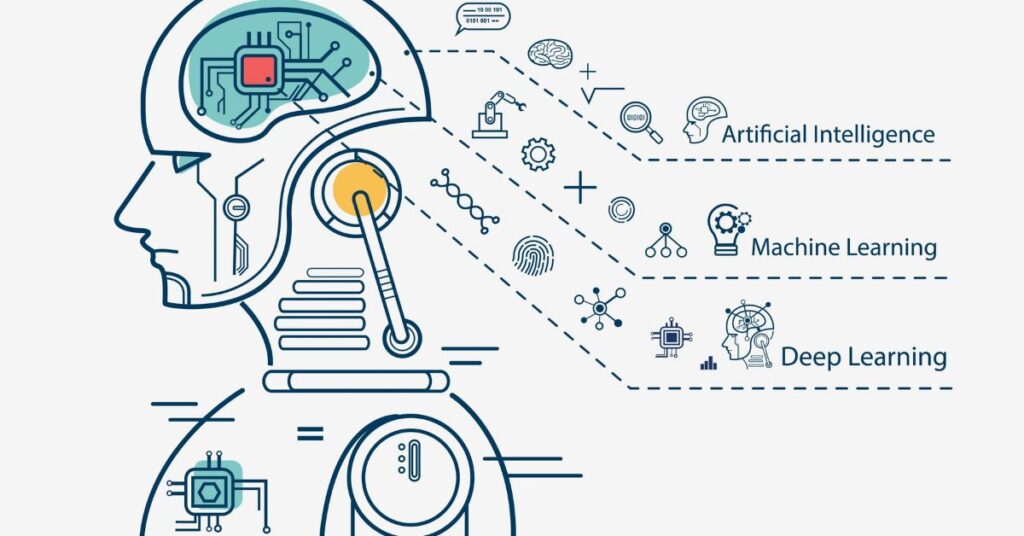
Many people use machine learning and artificial intelligence as if they mean the same thing. However, they are different. Artificial intelligence is the broader concept. It focuses on creating systems that can perform tasks that usually require human intelligence. Machine learning is one branch of artificial intelligence that allows systems to learn from data.
Artificial intelligence includes areas such as robotics, natural language processing, computer vision, and expert systems. Machine learning focuses on identifying patterns, making predictions, and improving performance through experience.
For example, a voice assistant uses artificial intelligence to understand speech and respond to questions. Machine learning helps the assistant improve its accuracy by learning from previous interactions. This relationship shows that machine learning supports artificial intelligence, but artificial intelligence includes many technologies beyond machine learning.
| Feature | Machine Learning | Artificial Intelligence |
| Definition | Learns from data | Simulates human intelligence |
| Main Goal | Improve predictions | Perform intelligent tasks |
| Learning Method | Uses algorithms and data | Uses multiple AI techniques |
| Scope | Subset of AI | Broad field of technology |
| Examples | Recommendation systems, spam filters | Virtual assistants, robots, autonomous vehicles |
Future of Machine Learning
How Machine Learning Will Shape Tomorrow
The future of machine learning looks very promising. More organizations now invest in AI-powered solutions. As computing power grows, machine learning models become faster and more accurate. Businesses use predictive analytics to improve planning and reduce costs.
Healthcare will continue using machine learning to improve diagnosis and develop personalized treatments. Education will provide customized learning experiences for students. Agriculture will increase crop production through smart monitoring systems. Transportation will benefit from autonomous vehicles and intelligent traffic management.
Generative AI is another major area of growth. Modern AI systems can generate text, images, videos, and software code. These technologies depend heavily on machine learning models trained on large datasets.
Edge computing will also increase the use of machine learning. Devices will process data locally instead of sending everything to cloud servers. This will improve speed, security, and efficiency. As research continues, machine learning will become an even more important part of everyday life.
Best Practices for Using Machine Learning
Building Successful Machine Learning Projects
Organizations achieve better results when they follow proven practices. They begin by defining a clear business goal. A machine learning project should solve a real problem instead of using technology without purpose.
Teams should collect reliable and diverse datasets. They should monitor model performance regularly because business conditions change over time. Updating models with fresh data helps maintain accuracy.
Security and privacy should also remain priorities. Organizations must protect sensitive information and comply with data protection regulations. Regular testing ensures that models remain fair and unbiased.
Businesses should also invest in employee training. Skilled professionals understand how to develop, evaluate, and improve machine learning systems. Continuous learning allows organizations to benefit from new technologies as they emerge.
Conclusion
Machine learning has become one of the most important technologies in the modern world. It helps computers learn from data, recognize patterns, and make accurate predictions without constant human programming. Businesses use machine learning to improve efficiency, reduce costs, enhance customer experiences, and make smarter decisions.
From healthcare and finance to education and retail, machine learning continues to transform industries. It supports automation, improves productivity, and creates new opportunities for innovation. Although challenges such as data quality, privacy, and bias still exist, organizations can overcome them through careful planning and responsible development.
As technology continues to evolve, machine learning will become even more powerful. Companies that understand and adopt this technology today will be better prepared for tomorrow’s digital world. Learning the basics of machine learning is now valuable for students, professionals, business owners, and anyone interested in the future of technology.
Frequently Asked Questions
What is machine learning?
Machine learning is a branch of artificial intelligence that enables computers to learn from data and improve their performance without being explicitly programmed for every task.
What are the main types of machine learning?
The three main types are supervised learning, unsupervised learning, and reinforcement learning. Each type solves different kinds of problems using different learning methods.
Where is machine learning used?
Machine learning is widely used in healthcare, finance, retail, education, cybersecurity, transportation, manufacturing, agriculture, and entertainment.
Is machine learning difficult to learn?
Machine learning becomes easier when you understand programming, mathematics, and data analysis. Beginners can start with Python and basic machine learning libraries before moving to advanced topics.
What is the future of machine learning?
The future of machine learning includes smarter AI systems, better healthcare solutions, autonomous vehicles, personalized education, advanced robotics, and more efficient business automation.
